Wednesday, September 17, 2025

Harvest Time


It is harvest time in Damongo. This generally lasts from end of August until the beginning of November. Unlike last year's rather devastating dry 'rainy' season, this year's rainy season (April-September) has been conducive to a healthy crop growth. These include corn (maize), tomatoes, peppers, okra (okro), casava, yam, and a variety of other fresh produce. These are not only vegetables that the local and national economies depend upon, but are also a very personal issue as so many use farming as a second means of income.

Today I joined some of the Diocesan staff as they harvested 'granut' - colloquially; or 'ground nut'; or, as we would say in America, the peanut. (When I first arrived, I was confused, the word sounded like 'granite' to me, as in 'granite soup'; not so appetizing sounding...🤣).

The Diocese’s land in Damongo is used the same way individuals use it; as a source of income; a vital way to help fund life. As with most work here, 'granut' farming is very labor intensive. The plant is hand-pulled from the ground and then the nuts (which grow underground, hence the name) are plucked from the plant. Then they are shelled, often by hand, though there are mills here for the larger quantities. Unlike what Americans buy in the grocery store, and eat at sporting events and bars, the seed here is usually eaten fresh. Roasting and boiling are done, but it seems a great majority is either eaten 'fresh' (directly from the ground and unprocessed) or turned into 'granut paste' (peanut butter) and then used in soup recipes. As far as I can tell, I'm the only one enjoying the PB&J sandwich, which are not a thing in Damongo. However, as with most foods here, I'm pretty assured of eating in a healthy manner no matter whatever local food I ingest.


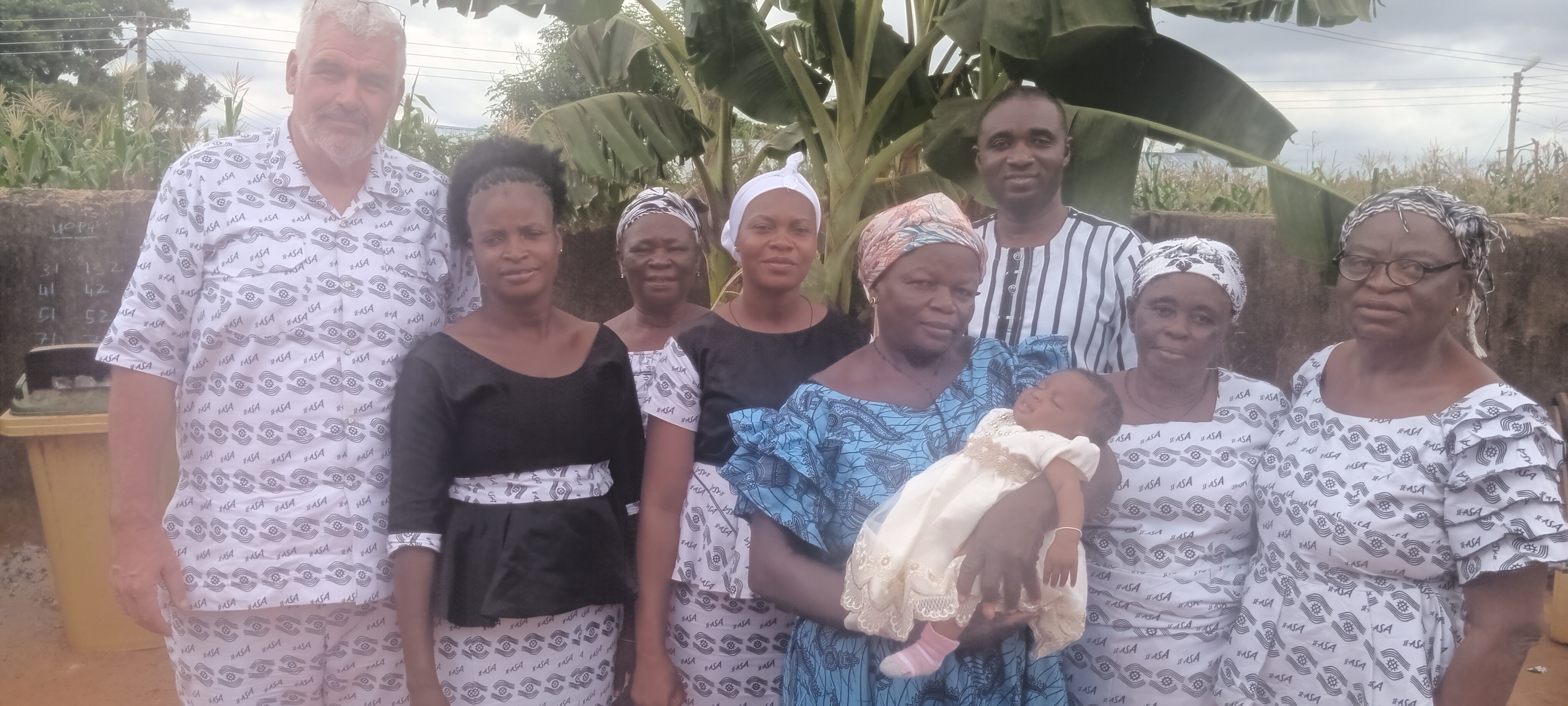
Aside from the actual production process, I am most intrigued and appreciative of the social aspect of farming. Economically speaking, the owner/farmer of the larger plots are unable to do all the work themselves. They employ laborers at a 75/25 split, generally. Socially speaking, families and friends gather for a common cause. It's not only time to work, but to talk and catch up with each other. Often, these humble people will gather together to help a small farming friend and the friend(s) in turn will gather when help is needed. This is a reciprocal arrangement where no accounting is asked of. It reminds me of the traditional Amish 'barn raising' that exists in my home of Northern Ohio.


My favorite aspect of life in Damongo is observing the way people with so little relative material will happily share themselves and their time. They are so generous with each other. 'Tribalism' has become a mostly negative term in America during the latter part of my lifetime. To us it's a term that means choosing sides. Here, sides are sometimes also chosen, but more subtly; usually the 'tribal' connotation plays out so much more inclusively than exclusively. There are many enlightening things I am seeing here. Seeing people commune together where less money and technology are involved, achieving a common, humble goal is foremost among them. Perhaps there are many more things we can learn from those we consider 'less fortunate' than ourselves? Observing the 'more developed' world from here, I, for one, am open to accept whatever they have to offer...


PEACE


Monday, July 7, 2025

Vital and Exhausting Work

A few weeks ago, I posted some information and pics (on FB) about the very vital and exhausting charcoal producing process. For most people here in Damongo, it is the only fuel for cooking and thus a staple and part of life. There is no Kingsford in the stores here. 🤣


The first step is to gather very large tree limbs up to 100 pounds. Next, the wood is set fire and covered with fresh leaves and dirt. Then, it smolders for a week or so. When it is finished and cooled, it is then excavated, sifted, and placed in bags. From beginning to end, at least 15 hours of labor each from 3 people working on one mound that produces 5 bags at $5-6 per bag. 


My own role is generally to haul the wood to be burnt and the finished product to its destination in my truck. These being my good friends, I also provide a few drinks.🤣 These particular workers are volunteering their service free of charge for the church. Back-breaking work, done on weekend off-time for free, for a common purpose. Well done, indeed.

Oh, lest I forget: with smiles on the faces. Smiles are very common here. The women, in particular, still have to find time to clean, dress and feed their children, and take care of the family laundry by hand, regardless of this commitment.

I am continually amazed about how life here - simple, yet riddled with hardships most westerners cannot fathom - is generally led without complaint. Most of them don't know the life we know in the US (the life many of us DO complain about). Come to think of it, maybe not knowing that life is why I see so many smiles here.


Monday, May 19, 2025

Two-Thirds Marker

I have crossed the two-thirds marker of my initial commitment of three years here in the Damongo diocese. There have been more than a few challenges. I won’t lie. However, the challenges have paled in comparison to the personal rewards. I came to Ghana with few expectations; only with vague hopes of doing some good for a people I knew very little about and to gain experience and growth as person. As for the former, I can only hope. As for the latter, it’s a clear confirmation that continues to grow with each passing day.

After my valuable formation at Lay Mission Helpers in late 2022, I landed in Ghana in early February 2023 filled with much more exuberance than one might expect from a 57-year-old man. I was seemingly ready to take on the challenges resulting from my experience of my most recent career: facilities manager and handy man. Soon thereafter, when the Diocese realized I had restaurant/bar management experience, they added an advisory role to my duties by engaging me to help run the restaurant and bar. At the end of 2023, through the generous contributions of people like you, we were able to refurbish a truck, which enhanced both of those positions and added the third title of Unity Centre driver to my growing resume. At the end of 2024, due to circumstances, I was asked to be ‘Acting Manager’ of the entire Unity Centre operations (restaurant, bar and guesthouse) and it’s approximately 25 employees. I accepted this 4th position with a certain reluctance.


My reluctance was fueled by conflicting thoughts: First, the 21st century lay missioner is taught to go to another land to aid and assist; not to impose. An American volunteer with authority over a group of Ghanaians in many ways seemed to cross certain lines within me, though I fully understood I was the most obvious choice - due to experience - until a permanent solution was found. On the other hand (and there always is an ‘other hand’ BTW), God places us where we are supposed to be and we are asked to try to accomplish what we are capable of.  I firmly believe that. All of us are able to accomplish more than we even know. So, the position that was supposed to be filled by March 31st continues to be filled by Damongo’s ‘Obrani’ (white man) missioner for the foreseeable future. I hope I am doing my best, but I won’t lie if I tell you that I am looking forward for the permanent hire to arrive and going back to my more humble duties.


In the end, my experiences so far have been very positive. I have helped to expand the restaurant by building 2 meat stands, enclosing the outdoor dining area and the outdoor cooking area, fixing what needs fixing, using the truck as a way to both save money for the Diocese and help employees in various ways. As manager, I delegate carefully; preferring to work alongside people as opposed to being a ‘boss’; resisting ordering people around.


I find myself very comfortable here in Damongo among the people. It’s like living in a nostalgic American small town of yesteryear, in a way. When I go to town, everyone greets each other warmly. I am creating relationships with the people here. From across the globe, somehow, we accept each other. Isn’t that what being a Christian is, after all? I’m most grateful.


My ‘official time’ is up early next year. Based upon the first two years, I have decided to extend for a fourth year and I thank you and LMH for your continuing support. I miss the US and especially look forward to meeting my 1st grandchild, Jameson (born in November 2024) and reuniting with my two children when I return briefly in early 2026. However, I must look at where I am most useful. When I look at it through that lens, it’s clear to me that I’m most needed here on many levels. A common phrase in Ghana is, ‘It’s not easy.’ Very true, and ‘easy’ rarely dictates the essentiality of things. I am happy to realize that I am where I am supposed to be and that’s gratifying. Again, I thank you all.


PEACE             


Monday, December 23, 2024

Christmas In Damongo

Now that the anxiety and excitement of the Ghana presidential election is over, it’s time for the people of Damongo to do what they do best- celebrate the holiday season. The days before Christmas will be filled with events that will allow celebration, relaxation and joy. The Unity Centre and its hard-working staff are front and center as they close the year in style before regrouping and setting new goals for 2025.

The weekend of the 21st kicked off with a double wedding of two men working for the Diocese, an accountant and a driver. Bishop Peter Paul officiated the special occasion at St. Theresa’s Parish Church. The ceremony itself was much more a vibrant celebration than the ritual that we are used to in the US. There is very heavily percussioned dancing, singing, and balloon decorations within the church itself; a nice blend of ceremony and the beginning of the reception which was held in the parking lot immediately after, where jollof rice (a national favorite) and chicken was served to all in attendance. Weddings here are very cost prohibitive to the couples relative to salaries. On top of that the groom must come up with a dowery for the bride’s family to satisfy tribal obligations. Hence, there is rarely any type of honeymoon, nor is there any help from parents or many gifts of money. The couples here are truly there to celebrate their commitment and love with all of their family and friends. Weddings like this are quite a sacrifice and I am always honored to take part. Best of luck to Evans and Vivian; Iraneus and Mildred! Cheers!

The following day, Sunday was the date of a revival of a past, yet discontinued, annual event- The Holiday Couples Dinner. From what I understand, this event was held in previous years and our Unity Centre leadership group has decided to revive it. We had approximately 75 people for this soon to be annual event, which featured dinner, drinks and music provide by a very interactive DJ. By any standards, it was very successful- certainly, a foundation for future annual events and a holiday staple.

The employee Christmas party capped off the long holiday weekend on Monday. The day began with a mass presided over by Bishop Peter Paul. The staff then gathered outside in the outside bar/restaurant area of the Unity Centre for the end of year celebration. Each employee was presented with gifts of food staples from the administration as well as a couple of drinks as a token of appreciation for the hard work provided in 2024. A good time was had by all.

Despite the fact that Damongo Christmas does not have all of the trappings we are so familiar with in the west- decorated trees and other nick-nacks, Black Friday sales and similar commercializations, Santa Claus, etc., my 2nd Christmas here has been most gratifying. Frankly, I don’t miss those things. Here it is truly a time for true celebration; a time to renew friendship, to review the previous year and to commemorate the birth of Jesus. Certainly, I miss my American family, including my first grandchild who was born a month ago and who I will not see until early 2026. However, I feel that my ‘family’ continues to grow where I am, which makes me so grateful and growth is something we should all strive for. Here in Damongo, the Christmas spirit is fully present in the people. This is where I live now. I am thankful to carry all of you with me on my mission which is the reason why I know I will succeed. Peace and all good things to all of you and all you hold close. Merry Christmas! 

Monday, August 19, 2024

Funeral Memorial

I have just passed the halfway point of my 3-year commitment in Damongo working for the Diocese. The work itself has been very fulfilling. However, even more fulfilling has been my immersion into the local culture. I count many Ghanaians as friends. We work together. We eat together. We celebrate together. We even commiserate together, at times.

The culture here is much more communal than that of America. For a variety of reasons, I think it’s something we in the US have lost over the years. There are 35 tribes in Ghana. Locally, the Gonjas are most predominant, with the Dagarre and Frafras making up most of the local smaller Catholic population (as compared with Muslim - largely Gonja tribe). These two tribes have migrated from the Upper West and Upper East regions of the country, respectively. Certain tribes here associate in a joking way with another, which is the case of the Dagarre and Frafra, referring to each other as ‘playmates.’ I am continually interacting with both and I enjoy the banter between them.

Over the weekend of August 10th and 11th, I had the honor of taking an active part in the memorial service for Charles Naagieh, a local Dagarre man, who lived fruitfully as a farmer and held various other jobs during his time in Damongo. I actually met Charles on his deathbed, on the last day of his 82-year-old life. 

The foundation of the communal life here is tribe/family. In addition to the birthing parents, aunts and uncles are also referred to as fathers and mothers, as are other tribal elders, to a lesser degree. The same holds true of cousins referred to as brother and sister and tribal aged contemporaries. This inclusionary way of living means nobody falls through the cracks here. It also makes the planning of funerals and weddings very difficult because of travel and the desire to have everyone present. Such was the case with Charles.

I became aware of Charles through his daughter (fraternal niece), Cynthia, who works at the Catholic Secretariat. It was made known that Charles needed blood. I answered that call, donating on June 28th 2023. I met him afterward and joined the family in prayer around his bed. He expired the next day. Because of the aforementioned travel coordination, Charles was buried about 6 weeks later in his hometown of Nandom, Upper West Region about a 4-hour drive away. The 6-week period between death and burial is very common here. I have heard stories of up to a year between the events. August 10th and 11th 2024 were set as the local 1-year memorial in Damongo so that those who could not travel to Nandom in 2023 could celebrate Charles life. This type of memorial is also a strong tradition among the Dagarre people.

As in nature, I believe that the birth death cycle is the foundation of our own relationships with each other and the world. Through my very brief interaction with the dying Charles, a very strong friendship developed with Cynthia and her extended family. I attend church with her, her sister, Mary and their children each Sunday. We regularly visit Dinah, Charles widow, for a beer or Pito, a traditional local drink. Truly, I feel as part of the family.

A few weeks before the local celebration, the family presented me with the cloth they had all dressed in at the funeral the year before (another unique tradition). I brought cloth to a local tailor who fitted me with an outfit that I wore to the concluding Sunday mass on the 11th, along with the rest of the family. I also took an active part in the rest of the festivities that weekend which included food preparation and pito brewing by the women, traditional dancing and an all-night vigil complete with prayers on Friday night. 

The memorial mass the next day was followed by the party for about 100 people, which included a DJ and dancing, a meal for all who attended, and a few complimentary drinks. It warms the heart to see people with very few resources providing all comers with food, entertainment and memories in the name of their patriarch. A good time had by all. Sunday included the regular mass with close family members (myself included) adorned in the traditional matching outfits followed by another meal with the same group (about 20 of us). My main contribution over the weekend was transportation in helping to procure drinks and water, using Unity Centre refrigeration, and providing rides to the depot, as out of town people caught their transportation home. With my own family half of a world away, it’s very comforting to be so included in this one here.

Again and again, I find that engaging the world and people around me leads to wonderful relationships. We can never have too many good people in our lives. They are all around you waiting to be met. The more diverse the group, the better. As a matter of fact, due to the language differences, I find that I have to work quite a bit harder to express myself and to understand what is said to me here in Ghana and that extra concentration bears bountiful fruit. Bridging differences is indeed a very strong bond. As Mother Teresa so famously said, ‘Make your own Calcutta.’ Reach out to those around you in a mindful way. The sky is the limit for the spiritual rewards you will reap. 


Monday, July 1, 2024

Barka de Sala


One of many interesting things I have observed in Damongo is the way the various religious faiths get along so well. Northern Ghana is roughly 80% Muslim and the remainder Christian and a mix of Traditional African Tribal religions. June 17th was the Muslim observance of Sala, the ending of the fasting of Eid al-Adha (Abraham's sacrifice of the ram) holiday. The town was abuzz with positive activity. There were feasts of bbq'd meat everywhere. Well dressed people proudly walking around with smiles. The salutation, 'Barka de Sala' (Enjoy your Sala) is not limited to the Muslims. It is an observable and joyful heartfelt greeting shared by everyone.


Where I come from in America (Cleveland, Oh), the Muslim population is so small that the community was never on my life's radar. It's probably that way with most of the readers here. Due to media coverage and the way we learn history, I believe it's safe to say that most of us in the West believe there is an ever-present contentious feeling between the Abrahamic religions (Muslim, Christian and Judaism all share their geographic and theological roots in the figures and stories of the Old Testament, most prominently Abraham and Moses). We have become almost numb to constant Middle East squabbling and warfare since the Crusades almost 1000 years ago. Currently, our media often seems to pit different cultures and beliefs - which share far more similarities than differences - against each other for no more reason than ratings. 

I'm not naive. I fully understand that some radical followers of these religions have promulgated conflict for millennia all over the globe. But what I can report is that my observations on the ground in Ghana present a much more refreshing and optimistic reality. The people here share common struggles - poverty, health, environmental issues, among others. Which God is more 'powerful' or 'righteous' tends to pale to irrelevance in comparison when presented with such day-to-day realities. They depend on each other. Religious 'pedigrees' tend to pale in comparison.

There's an old Hindu saying in regard to religion and God: 'When there are so many fingers pointing toward the moon, we tend to concentrate more on the fingers than the moon itself.' How true. The world has many troubles (in addition to so many more wonderful and astonishing attributes!). Religious beliefs serve as a consolation and provide balance to many believers. That's what they're meant to do. When they divide, they are counterproductive and need to be rethought. It is so important to always be willing to grow and change for the better. Your brothers and sisters are all around you. Chances are, they have the same fears, mistrust, dreams and love that you do even though they may look different or follow different customs. Don't hesitate to reach out to each other. Disregard self-incubated, deluded and often paranoid reasons for your motivations in relation to others. 

I'm quite sure that the many things I observe on this part of my life's journey in Damongo are much more a learning dynamic than any attempts at teaching anything. I realized that going in. Of course, we should always be cognizant of doing both - learning and teaching. That is what life is ultimately all about. Barka de Sala, Happy Easter, Shalom (or any other heartfelt inclusion of others) are really all the same in the end. It's love. It's informing your neighbor that you wish them well; that they should celebrate the day, our dependence upon each other and our very common existence. Don’t just relegate it to designated holidays. Celebrate and include everyone everyday. Spread the love that is the only relevant energy of the universe.

Do you really think that the God we follow actually differentiates between how you profess it or act upon that motivation? Can we be so arrogant? I, for one, believe in the better angels of our collective nature.

PEACE

Tuesday, March 26, 2024

Growth Is a Gain Not a Loss

The most common misperception about missioning work is that it is a process of privation- giving things up and even enduring an amount of suffering. I find that nothing could be further from the truth. Certainly, there is a fair amount of adaptation - new culture, language, food, etc., but these things tend to add to personal growth after the initial ‘shock’ upon arrival. Growth is a gain, not a loss, after all. Many of those things that we grow to believe are ‘necessities’ are really conditioned comforts in most cases and often hinder spiritual growth, especially when we mistakenly believe they are responsible for our happiness.

I am fortunate in my capacity in helping to manage the restaurant, bar and guesthouse that I am able to meet and befriend such a wide variety of people, including all of the wonderful younger people that I work with. While many of them have desires for the things that we take for granted in the West, I rarely get the feeling that they are complaining about their individual situations.

While there is a universality in the way all people perceive the world, we all want the same basic things- security, health, purpose and love-, it is our uniqueness which spurs our spiritual growth and perceptions. There is no shortage of unique people here. There is Lazarus, the talented young German-trained electrician who patiently helps me navigate a very different electrical grid; Richard, who is my own age, alternately working as a plumber and chicken farmer. He is always able to provide sage cultural advice and good humor; Moses, the nursing school instructor, who is well versed in so many diverse spiritual practices, not least of which are those ancient African tribal traditions; Gifty and William, the stationary/boutique/plumbing supply proprietors, who stop by a few nights per week to share their delicious homemade cuisine with me; there is Mathias, also known as ‘Zero Minutes’ because he is always busy and willing to quickly lend a hand to whatever job needs being done; conversely, there is Dennis the tailor, aptly named ‘Come Tomorrow’ who I gave a pair of pants to refit and regrettably told him I was in no hurry to have them back. He returned them 8 months later! These are just a few examples. It seems each day brings new personalities and thus opportunities to grow into my life.

Yes, I miss certain things from my home, especially my grown children, but none of these things even close to the point of distraction. It is true that I don’t have a grocery store here with mile-long aisles of cereals, meats, fruits and vegetables. There’s no McDonalds, Starbucks or 12 lane highways either. However, I do have a local market where the food is farm-to-table, lacking any injections of chemical preservatives that most of us cannot pronounce and even fewer of us want to know why they are ‘necessary’; and I do know how to cook. Travel is slower, but, like most people here, I’m in no hurry. There’s a lack of heavy industry and its inherent pollution.  The electricity goes out sporadically and the internet can be spotty at times, but I stopped watching TV years ago and I don’t depend on the web so much. So, I’m lacking processed and fast food, faster cars, heavy industry, and gourmet coffee. Necessities? Hmmm… Yes, it can be a bit warm here (ha-ha), but my physical health has never been better and my inner peace is flourishing. Life is far from perfect for the people in Damongo of which I am now one, yet I am always struck by the fact that they seem far more happy and less anxious on the whole with what appears to be so much less than the culture I was raised in. Perhaps we’ve gotten the whole ‘mission thing’ wrong. Perhaps it is places like Ghana that should be sending their missioners to places like America.               


Tuesday, February 6, 2024

The View From Here

With the month of February comes the beginning of the very hot dry season here in Damongo and also marks the end of my first year of service. The perception is usually that mission service is a sacrifice. While I understand that at a very simple surface level, I never really looked at it that way. Even before I arrived, I knew that my calling was one of spiritual enrichment. While I was coming here to share my talents and experiences with people I did not know on the other side of the world, I was more keenly aware that I would be gaining much more from them - learning about a new culture, challenging myself and thus growing. How could gaining those things be considered sacrifice? I have not been disappointed in my expectations. The people here are very gracious and thankful. I do my best to reciprocate. They say that time flies when you’re having fun. It has. And I am.

My duties here have mostly entailed trying to make the Diocese of Damongo’s sole source of income, The Unity Centre, a more viable and profitable venture and thus bolster the Diocesan pastoral mission to provide for its people. With my background as a restauranteur, I have been able to advise management and staff on universal practices such as organizing and expanding the menu, profit margins and labor management. My contracting experience has enabled me to construct a low fence around the property to keep vehicles and roaming animals away from dining and drinking areas, enclose areas of the restaurant and bar for more efficient operation, replace doors and locks to maximize security, install cameras and lighting to ensure safety and adding a modern stereo system at the bar.

Over the holidays my restaurant and contracting skills combined to create a new grilling station near the bar area by reusing material stored in the warehouse. Just as Americans consume chicken wings and other appetizers, the people here crave those quick and easy foods while they relax with their favorite beverage. Of course, the cuisine here is different, though western influence is expanding food desires as well as a plethora of other items through internet connectivity. There is a demand to have those things that we have in the West. Since the end of the year, our grilling menu has expanded to include skewered beef sausage, chicken gizzard and other popular meats as they are available, as well as guinea fowl (a popular local poultry) and tilapia. Future plans will include such western staples as hamburgers, french-fries and constructing an adjacent station devoted exclusively to pizza which is popular the world over and also a specialty of mine. I am also planning to renovate the bar itself with new tile flooring, a fresh coat of paint and design to give it distinction and a big screen projection TV, as sports and beer are also very popular in this soccer-crazed part of the world.  


The much-anticipated Jubilee House, a brand new 3 story, 34 room guesthouse, also opened at the end of the year. Damongo was named the capital of the new Savannah Region of Ghana five years ago and is adjacent to the internationally renowned Mole National Wildlife Reserve. The diocese is priming itself to be on the cutting edge of all the expanding demands of growing population and tourism. It is my job to help in that process.

I am also very thankful for the refurbished truck that was provided by generous donations last November. Not only does it help in general operations- procuring restaurant and bar supplies, as well as my own contracting material, but is also utilized for getting some employees to and from work, as well as church, and a variety of other uses. Travel is difficult here and costly. The average employee makes about $45 per month. Rides to town, where most of them live, costs about a dollar round trip. As I try unsuccessfully to do the math of individual monthly budgets of those I work with, I’m convinced that the community values which inspire the people here to share and look out for one another is the glue which holds this place together. It appears the truck has become part of that glue.

As I stated in my opening, my learning and spiritual growth here greatly outweighs any perceived sacrifice. Sure, I miss my adult children and occasionally see mouth-watering food items on social media that make me miss my home and its luxuries. However, watching the ways that people move forward here with far less of what we normally measure our society by- capital, industry, infrastructure, etc.- is truly inspiring and I am more than honored that they accept me and let me take part. The one asset that is not so measurable, but in great supply here, is human spirit. Through cooperation among each other and support from outside groups and donors like Lay-Mission Helpers, I find myself growing by observing and living with a people who do not accept defeat from a world that often measures ‘success’ in ways not so natural to them. While the mission plan here is invaluable, I often think that in many ways the people of Damongo could teach those of us in the West a certain spiritual mission work of their own. The view from here makes that point difficult to ignore.

Friday, January 12, 2024

Receiving

‘…it is more blessed to give than to receive.’ (Acts 20:35)

These words, attributed to Jesus, are familiar to all of us. They are especially relevant during the holiday season. We are taught that it is the giving that is most important; being selfless and by doing so, enriching our spirit and growing closer to God. Few of us could argue with embracing this ideal. However, receiving is also very important. Not in keeping track of how much we can accumulate or how we can satisfy our very fleeting material desires, but in the very way we receive from others. Just as each of us gains spiritual growth in our own giving, it is very important that we allow others, especially those of limited means, the dignity and joy of participating in the process. This is one of the most important lessons I have learned during my first year in Ghana.

In all humility, giving has always come very easy to me. Growing up in way that my basic needs were always provided for, and having the ability to work gainfully as I entered adulthood, I always felt very blessed in what I had and was not so attached to any of it.  I rarely said no to the idea of giving.

I find my natural predisposition to give allows for spiritual joy within. It makes me happy. It does the same for all of us. And who doesn’t enjoy the inflated ego that comes with others telling us, ‘Wow, you’re such a great guy (or gal)’ as they pat you on the back? This dark side of giving is why it is so important to give quietly and humbly. The ego has a voracious appetite that will never be satisfied once we give in to its infinite desires. It is a monster that will devour us.

Over the years, I found that I was much more uncomfortable receiving than giving. Of course, I always appreciated when another person took the time and effort to give to me of themselves.  It is no great surprise to me that I have ended up in a place like Ghana, where so much giving is needed. However, accepting the gifts of others is a very foundational cultural norm here. Indeed, it is insulting to not participate in this way.

Coming from such a wealthy country like America and coupled with my predisposition to give, accepting from people of observably much less means can be difficult. For instance, in this culture a person passing by another or a group that is eating is always invited to join. They are very group oriented and much more inclined to share than what I see in our own culture. When offered food, my knee-jerk reaction is to think that I have plenty at home and more money in my pocket than the person offering; that they need it more than I do.

Recently, I provided a ride to a single, pregnant mother of very limited means and her son. She asked that we stop and pick up a small snack at a roadside stand. She bought three. It was late, and knowing I was going home to my well-stocked kitchen, I politely declined when offered one, figuring she and her son needed it more than I did. My reasoning was very well-intentioned. As I thought about it the next day, it struck me that I was denying her the pleasure of giving by not receiving. Not letting her thank me. When I spoke to her about it and apologized, I found that she was a bit angry about it. She had good reason. Just because we have more does not give us the right to diminish the dignity of another, no matter how well-intentioned. It is a participation, not a competition. I’m quite sure I have done this same thing many times in my life without realizing it.

So, I have learned to receive from others graciously no matter who they are or how they appear. I have learned to participate in a more equitable manner; to not always strive to be the hero; to share the responsibility of being my brother’s keeper with others without judgement.

Is it truly better to give than to receive? Like most things in life, there are no absolutes. The ground we stand upon is always changing and so should we. By all means continue to give to those in need. You will see them all around you, unless you refuse to open your eyes. Enjoy your giving quietly. It is good for your soul. But also receive with the same generosity of spirit and an open heart as when you give and remember that all of us are called equally to participate in this spiritually nourishing process.      

Artwork by 8-year-old neighbor


Tuesday, November 28, 2023

Truck Has Arrived

It is with heartfelt gratitude that I can report that the Nissan truck that was paid for by the generous donations of so many family members, friends, and the extended family of Lay Mission Helpers has arrived after 7 weeks of extensive mechanical and body work. Not only were the repairs made, including a whole new engine, but there was enough donated to provide for fuel and miscellaneous expenses for the near future; thus, achieving the goal of alleviating any further strain on a Diocese burdened with plenty of other challenges.

The truck will not only provide immediate dividends in day-to-day operations of the Unity Centre, the Damongo Diocese’s sole source of income, but will also allow me to travel to outlying parishes to make much needed repairs and provide regular maintenance for buildings in need. My own appreciation is secondary. If I could only adequately express the gratitude that the people here feel for the kindness of strangers who live so far away willing to go outside of their own busy lives to help them, I would. My words do not suffice. Please allow yourselves a moment of satisfaction that you have indeed participated in God’s love in no small way by going beyond your own daily challenges to help your needy brothers and sisters on the other side of the world.

While I was discerning my present calling, a priest gave me some very daunting and valuable advice: ‘When God gets hold of you, He will always ask more.’ He failed to mention the other side of the ledger: attempting to fulfill such an obligation is more enriching than one could possibly realize. Indeed, it is us getting hold of God, who is always patiently present within us; realizing our individual callings to slow down, listen, and act according to our own unique, divine gifts.

Life is full of challenges here, but I live in a gratitude which grows by the moment, knowing that each day I humbly attempt to live in a way that continually nourishes my very soul. My only hope is that, in my own small way, I can provide small comfort to those who have become like family. Rest assured, they provide no small amount of comfort to me, as do you all. 

In the end, we are each indispensable links in the chain of God’s love, which is the energy of the universe. It is my fervent hope that, during this holiday season, you can focus not so much on the world’s chaos and those things which cause anxiety, but concentrate on the infinite goodness within yourself and those loved ones that surround you, knowing that that is what nourishes the world; that is what endures. Please keep the Lay Mission Helpers family in your hearts this holiday season. Their work is very noble. The fulfillment immeasurable. And again, THANK YOU!

PEACE LOVE & AMDG

To continue making a difference in this ongoing project or support my other works, log onto: www.laymissionhelpers.org, follow the link to ‘Mark McGraw’s Mission’ and press ‘DONATE’.


Tuesday, August 29, 2023

Transportation Needs

‘It’s not easy’ is a very common phrase that I hear in Damongo. I joke with my new friends that it should be the motto underneath the Ghanaian flag. Perhaps it could be translated into Latin: ‘non facile est.’ In truth, things being easy or not is a very relative term. Arguably, none of us has it ‘easy’. When I hear the phrase in Ghana, it is not said with any resentment or sadness. It’s just a statement of fact. The people here are amazingly resilient. Many are used to living on the fringe and making due with what little they have. Being very community and family oriented certainly eases the burdens, at least spiritually. Their traditions place great value in looking out for each other and sharing. Frankly, it’s something that we have lost in the West and could relearn from them.

One of the biggest obstacles here is transportation. While the costs of basic food, shelter and clothing are very relative in the developed and less developed areas of the world, vehicles and fuel are not. Like most developing countries, the most common form of getting from one place to another in rural Ghana is by foot, a healthy tradition I have happily embraced. Longer distances are most commonly traversed by means of bicycles, scooters and small motorcycles. When you see a car or pickup truck, it’s common to see upwards of 15-20 people in and on them (and 4-5 on a cycle!). These are the basic ways Ghanaians attempt to address fuel and vehicle costs. For reasons I will clarify, my role here as a contractor and facilities manager often demands a more utilitarian means of transport: a work-dedicated and shared-usage pickup truck.

The Diocese of Damongo is 11,000 square miles in area (a little larger than the state of Massachusetts) and serves approximately 410,000 people in 13 parishes. While my work is mainly centered at the Secretariat and its Unity Centre Complex (guesthouse, restaurant and bar) as a manager and head of maintenance, there is also a glaring need for my abilities to repair diocese buildings in the outlying parishes. Unfortunately, there is currently no vehicle or driver assigned either to the Unity Centre Complex to take care of such things as food and beverage procurement and the transport of larger maintenance materials or for building maintenance at the outlying parishes. My proposal here will help to solve both issues.

The Unity Centre serves as the Diocese’s sole method of generating income, and often times the restaurant matron and I will engage private transportation to go into town and buy food, supplies and other materials which affects this very important bottom line. To maximize the efficiency of my manager/maintenance role here, it would seem that a vehicle, which is not currently budgeted for, is a necessity.

The Secretariat and the local and outlying parish ministries are the first line of defense in the battle against poverty (national per capita income is about $2200, but far less in rural areas like Damongo and the 13 other parishes). Equally important, is that the church serves as the source of spiritual well-being and community. The people here take great pride in their worship, always clean and well-dressed and participating with great energy in the weekly and special services. Like any other structures over time, the churches and other diocese buildings need repair and would greatly benefit from the simple, regular maintenance that I could provide and thus help to foster that pride and devotion that congregations and employees bring to the buildings. This is a large part of the reason Lay Mission Helpers sent me here and, as of now, is a scope of work that has yet to be addressed mainly because of transportation issues.

Currently, the diocese owns a vehicle (2008 Nissan D22) that needs @$4,300 in repairs to make it safely road ready for travel within Damongo and the more difficult travel to parishes further away. In addition, my licensing, insurance and miscellaneous fees would total @$1,000 and a years-worth of fuel and oil changes is estimated at @$1100 per year. The appeal I’m asking you to consider would total $7,500 (repairs, fees, 2 years of fuel and miscellaneous costs). Any donation would be greatly appreciated as I try to live up to the LMH credo and mission of ‘For we are God’s Helpers.’ (1 Cor 3:9)

You can make a tax-deductible donation on the LMH website www.laymissionhelpers.org by selecting the DONATE button and choosing “Mark McGraw’s Mission”.

Peace and prayers, & my deep thanks in advance!


Friday, July 28, 2023

Pivot

Here in Damongo, the people do not have the luxury of looking at a plate of food and wondering where it comes from. In most cases they can automatically trace it back to the seed or even the long-ago consumed plant that the seed came from. You see, everyone here is at least a part-time farmer. And when I say everyone, I mean EVERYONE- the priest (even the bishop), the accountant, the shop-keeper, the yellow-yellow (cab) driver, the children and everyone in between. Until now, everyone except this ‘roaming obroni’ (stranger) who wanders around town passing out suckers to children. It was past due time for me to pad my resume!

When the newly appointed Nun/Accountant approached me, the Contractor/Restauranteur/ Writer/Obrani-roamer, because she had found an unused 400 square yard plot of land that needed farming, what choice did I have? The restaurant needs food and also to cut expenses. Producing it ourselves helps to solve both issues. This is Ghana. I am here. It’s the rainy season. That’s all that matters. As it was already getting a little late in the season, I realized it was time to pivot. There wasn’t much time to ponder. It was time to get busy with some learning. To be a farmer. Time to be a Ghanaian.

So, I built a fence around the proposed area to keep my fellow ‘roaming’ creatures from sharing in our proposed bounty and then engaged the help of some willing teen-aged farmers in preparing the ground by plowing it. At this point the real learning was initiated. The Nun/Accountant/Farmer began to instruct me. I truly believe that the people here much prefer working the land to the various western skills their lives have been burdened with. Love, purpose and tradition can never be suppressed for long in any of us. They are like germinating seeds. Her eyes gave it away and we mindfully proceeded to navigate through our cultural and language divide. I learned about replanting shoots of tomato, where to place the ‘okro’- our main crop, which seeds to scatter, which to bury- how deep and how many in each hole. Pumpkin, meringue, red pepper, green pepper, beans and a few that I can’t pronounce and won’t know about until they produce fruit or leaves.

I have also learned to pay greater attention to the rain, no longer just concerned about the large cistern at my house being filled by my gutters, but more importantly, how it affects the welfare of those seedlings meant to feed those who are now ‘my people’ and whether I need to haul water when the universe is sleeping on the job. I was also quickly developing an empathy about how it affects my brother farmers. I’m sure I will learn about weeds- unfortunately, the rain benefits the invited and uninvited equally. I hope I learn much less about pests and blights and way more about harvest and food preparation. But besides my desire, most of these things are largely out of my willing hands. They might even require further changes of direction.

My latest pivot has altered my routine in a very positive way. The garden (farm?) is mine to steward for now and for the foreseeable future. It is close to the office I walk to and checking on it each morning- gaging its growth- has become a new and welcome highlight of my day as I optimistically imagine it’s yield. Through learning, I have diversified my purpose, finding another way to value my neighbor through that most basic shared connection- the earth.


Monday, July 17, 2023

Achieving Balance

In every situation we encounter in life, there is a sense of both known and unknown. The known is our experience, the unknown our openness and willingness to learn. Achieving a healthy balance is a key to a fruitful existence.

Recently in Damongo this balance was revealed to me in a very real way. Since I arrived, I've wanted to introduce pizza to the restaurant I'm helping to run and to the area in general, figuring it to be pretty universally popular type food and an untested market for financial growth for a Diocese short on money. I have 45 years’ experience in making pizza, including about 25 commercially. In Damongo, that would make me the expert, right? Kind of... 

You see, some of the younger people here have tried pizza a few times in the bigger cities and have their own ideas of what it should be that are different than mine. When they sampled my version, I was critiqued in ways that I did not expect, and at times had to resist pushing back based upon my relative experience. However, I resisted, realizing that I'm not making pizza in Cleveland for Clevelanders. I'm making it in Ghana for Ghanaians. To be successful in this venture, as in any venture, sometimes means releasing the grip on our own ideas to make room for other, newer ones. Not abandoning one for the other, but achieving balance. That's how life works. 


Friday, June 30, 2023

Go Outside And Say Hello

I walk around Damongo and other parts of Ghana passing out small 'dum-dum' suckers to children. Yeah, I know. Kind of weird. I'd be hauled in by authorities in the US. Believe it or not, there's a method to my madness. 

80% of the area I live in is Muslim. Today was a little slow at work and I left a little early , as it's one of their biggest holy day celebrations: Eid al-Adha, which is a commemoration of Abraham's willingness to sacrifice his son, Isaac at God's request (Yes, God was bluffing. And, yes, Muslims, Jews and Christians all share this story, among many other writings and traditions. Go figure.).

As I walked home, I passed a house where a few children regularly come out to collect their tribute. There was more activity than normal and a lot more kids emerged from the house. Thankfully, I was well supplied. We shared greetings and suckers. But before I left, one of the adults beckoned for me to come inside their fenced-in yard. Soon I was sharing pleasantries and smiles with 30-40 people despite the language barrier; snapped a few pictures; and was invited to their feast of roast lamb tomorrow when I pass by again. Because of my strange little habit, I now have 30-40 new friends.

Why am I telling this story? Like the US and every other country, Ghana has all sorts of cultural diversity; based on tribes, languages and religions. As we all know, these can be wonderful things but can also lead to mistrust and worse. I find that people are people- everywhere in the world- sharing many more similarities than differences. Often your ethnic group, government, religion or favorite media outlet will try to convince you otherwise. Turn off your TV. Go outside and say hello to someone you don't know. Offer them a piece of candy! You never know. You might end up with a new friend or even a plate of BBQ. One thing for sure: you'll never know unless you try.


Harvest Time

  It is harvest time in Damongo. This generally lasts from end of August until the beginning of November. Unlike last year's rather deva...